CONTROL PANEL ATTACHMENTS
SYSTEMS OPERATION
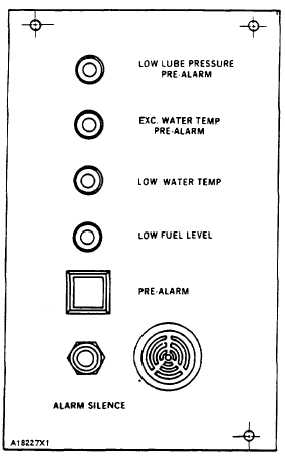
PREALARM MODULE (PAM)
The Prealarm module fits the requirements in
National Fire Protection Association-76A paragraph 631.
It fits in the right side of the control panel. The purpose
of the Prealarm module is to give a warning of conditions
that can become a problem before they are serious
enough to keep the engine from starting or running. The
Prealarm module activates its warning system for the
following conditions:
When the engine has one of these conditions,
the switch which measures it closes. This closes the
circuit to the indicator in the control panel for that
condition. The indicators are circuit breakers of the push
button type. When the circuit breaker first gets the
current from the switch, it is in its normally closed
position. The circuit is closed to the warning auxiliary
relay (WAR) which activates and closes its own hold in
circuit and the circuit to the alarm (ALM) which is a
warning horn. The circuit breaker activates and opens
the circuit to the warning alarm relay (WAR) and closes
the circuit to the preliminary alarm light (PAL). This
makes the preliminary alarm light (PAL) operate.
The preliminary alarm light (PAL) and the alarm (ALM)
operate until they are manually disconnected by the
operator. The alarm silence push button (PB). when
pushed by the operator, closes the circuit to the alarm
disconnect relay (ADR). It activates and closes its own
hold in circuit. At the same time, it opens the circuit to
the alarm (ALM) and to warning alarm relay (WAR).
When the circuit to the warning alarm relay (WAR)
opens, its contacts move to their normal positions. This
disconnects the alarm disconnect relay (ADR). When
the operator pushes the push button for the circuit
breaker, it disconnects the preliminary alarm light (PAL).
NOTE: If the engine still has the same conditions, the
alarm system activates again when the push button for
the circuit breaker is pushed.
The circuit which is between the indicator for low oil
pressure in the engine (LOW LUBE PRESSURE
PREALARM) and the oil pressure switch-preliminary
(OPP) is open until the run relay (RR) contacts and the
oil pressure timer (OPT) contacts are closed. The run
relay (RR) closes its contacts when the signal to start the
engine is felt. The oil pressure timer (OPT) starts to
operate at the same time. After approximately 90
seconds, the oil pressure timer (OPT) closes it contacts.
The oil pressure switch preliminary (OPP) opens at
approximately 19 psi (130 kPa) when the pressure is
increasing. It closes at approximately 15 psi ( 105 kPa)
when the pressure is decreasing. If the oil pressure
switch-preliminary (OPP) is closed for any reason. it
now causes the circuit breaker for the LOW LUBE
PRESSURE PREALARM to activate. The alarm system
activates normally from this point.
When the engine has a normal shutdown. the
circuit to run relay (RR) is disconnected. Run relax (RR)
contacts go to the normally open position in the oil
pressure circuit. This keeps the oil pressure switch-
preliminary (OPP) from activating the low oil pressure
indicator (LOI) when the oil pressure decreases because
of normal engine shutdown.
The alarm (ALM.) in the Prealarm module
operates when the automatic start-stop system causes
shutdown of the engine because of an engine problem.
When the shutdown relay (SR) is activated by one of the
switches in the automatic start-stop system, some of the
contacts close a circuit through terminal 39 which
activates the warning alarm relay (WAR). This causes
alarm (ALM) to operate. (See Note C.)
NOTE: This does not cause the preliminary alarm light
(PAL) to operate.
264